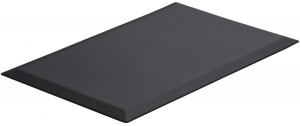
How an anti fatigue mat works is
well described in an article that was published in the April 1999 issue of
“Occupational Health & Safety”, written by James M. Kendrick:
“Anti-fatigue mats are engineered to
make the body naturally and imperceptibly sway, which encourages subtle
movement by calf and leg muscles. This promotes blood flow and keeps it from
stagnating in the veins, which causes workers to feel fatigued.”
Standing on hard surfaces for long
periods can lead to several problems. First, standing causes muscles to
constrict, which reduces the blood flow. This makes muscles and joints hurt,
and it causes blood to stagnate. In addition, long-term standing causes probation,
or excessive flattening of the foot. While this can be simply tiring and a bit
painful, it can also lead to plantar fasciitis and other serious foot
conditions. Lower back pain is highest in workers who stand 4 hours or more per
day.
As noted by Mr. Kendrick, the
cushioning effect of anti-fatigue matting allows continuous micro-movements of
the feet, which minimizes blood pooling in the legs. Too much
cushioning can have a negative effect. Too great an amount of softness or
“give” will actually cause excessive fatigue because it overworks the muscles.
Think of it like jogging on the beach as an extreme example of this concept.
Standing
at Work
In
numerous commercial ventures, representatives are required to work while
standing, strolling and/or conveying loads. Lower limit distress and weariness
from constrained long haul standing and strolling is an issue regularly
distinguished, however occasional recorded. Early concentrates, for example,
Morgora (1972) demonstrated that the frequency of low back torment was most
noteworthy in those specialists who stood consistently every working day for
times of over four hours and Bousseman et al. (1982) conveyed to light that
long haul standing is an immediate reason for agony and uneasiness.
Consequent
examination conveyed by Dr. Mark Redfern and Dr. Wear Chaffin at the Center for
Ergonomics, University of Michigan in 1988, and Paula Hinnen and Stephan Konz
at the Department of Industrial Engineering, Kansas State University, 1994, had
perceptions of the effect between remaining on hard floors versus remaining on
delicate floors. Both their studies reasoned that mats altogether influence
weakness and solace in various body areas.
New search
How an anti-fatigue mat works is
well described in an article that was published in the April 1999 issue of
“Occupational Health & Safety”, written by James M. Kendrick:
“Anti-fatigue mats are engineered to
make the body naturally and imperceptibly sway, which encourages subtle
movement by calf and leg muscles. This promotes blood flow and keeps it from
stagnating in the veins, which causes workers to feel fatigued.”
Standing on hard surfaces for long
periods can lead to several problems. First, standing causes muscles to
constrict, which reduces the blood flow. This makes muscles and joints hurt,
and it causes blood to stagnate. In addition, long-term standing causes
pronation, or excessive flattening of the foot. While this can be simply tiring
and a bit painful, it can also lead to plantar fasciitis and other serious foot
conditions. Lower back pain is highest in workers who stand 4 hours or more per
day.
As noted by Mr. Kendrick, the
cushioning effect of anti-fatigue matting allows continuous micro-movements of
the feet, which minimizes blood pooling in the legs. Too much
cushioning can have a negative effect. Too great an amount of softness or
“give” will actually cause excessive fatigue because it overworks the muscles.
Think of it like jogging on the beach as an extreme example of this concept.