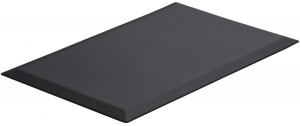
Searching for the right anti-fatigue mat for your standing
desk brings forth a daunting paradox of choice. They come in all sizes, colors
and quality of construction. Having analyzed many and written
more fully-detailed product reviews on various mat offerings than any
other expert review site, our simple advice to the reader is this: First figure
out what quality level best suits your needs, then narrow down
your choice of size, color, and shape.
Most purchasers would begin their pursuit by value run however one
of the primary things we found in our survey gathering is that the relationship among st quality and cost is not as a matter of course straight, and that truth
be told there are the same number of costly tangles of low quality (e.g. the Ergo tron Work fit Floor Mat at $199) as there are astoundingly great mats under
$100. There are likewise some intriguing, mixture "sit or stand
tangles" that join both seat tangle and standing mat into a solitary item,
for the individuals who need both.
Cheaper
Mats are Disposable
In general, cheaper mats are made with low-cost materials,
usually in China, and might as well be “disposable” because they’ll either
start coming apart or completely lose their buoyancy (“mushiness”) within
a year’s time. These were originally designed for kitchen/home
use and won’t last very long in an office environment. Some will off gas
volatile organic compounds (Doc's) from the chemicals used in their
manufacturing. But price doesn’t tell you everything. Take our only 5-star
rated contender, the made-in-America Asimov Eco Last Premium. It starts at a
mid-tier price of around $100, will endure office chairs being rolled over it,
is environmentally friendly, and comes with an
industry-leading, ten-year, full performance warranty.
A marginally more solid method for isolating the business sector
is to take a gander at private versus business grade standing mats. Private
mats will be much squishier and just give solace to maybe a hour at most, since
that is the length of the vast majority will utilize them in the kitchen. They
arrive in a wide assortment of hues and surfaces. They want to be utilized by
uncovered or socked feet, yet certainly not hard soles and heels, substantially
less stilettos. Business grade mats, then again, are particularly intended for
use at a standing work area, in dress shoes. They will be much firmer, and will
keep up their lightness all through the workday. They're likewise going to keep
going for a long time longer, and won't be effectively harmed by rolling a seat
over, or dropping sharp or substantial articles on them. Obviously, they'll
cost all the more, however a decent hostile to weakness mat is not something
you need to hold back on.
“Think
About Standing Mats the Way You’d Think About Shoes”
We observe this aphorism to be exceptionally able. In case you're the
kind of individual who strolls around in a $10 pair of flip flounders
throughout the day you're not liable to spend more than $50 on a retail
establishment kitchen standing mat. We know our peruses entirely well (since
we meet them in individual all the time at our Bellevue Trialing Center we
really do know how they by and large dress), and don't see an excessive number
of them wearing scratch and dent section shoes. There are numerous contenders
competing for piece of the overall industry in the $40-$60 territory, however
in the wake of testing them we'd irregularity practically every one of them in
the "dispensable" classification, regardless of their confident
showcasing claims and, at times, shockingly long guarantees (keep your receipt,
and note the fine print on the "constrained guarantee").
Much like
with athletic and strolling shoes, most better than average mats begin at about
$100 (for a 24″ x 36″ standard size). These mats are reason worked for the sort
of long-term standing workday that most standing work area clients are going
for. Extraordinary textured outlines and ornamentation will knock the cost up a
bit for standing mats, as will size. In any case, material expense and amount
(higher thicknesses, widths, and lengths require more material) is the
overwhelming lump of the valuing condition.
A Quick
Guide to Materials and Construction Methods Used in Manufacturing
Anti-Fatigue Mats
When it comes to method of construction, again we can
stratify the field into two distinct segments. Most, especially the lower-cost
ones, consist of an outer layer of rubber, vinyl, or polyurethane, with one or
more layers of inexpensive foam and/or gel inside to keep material costs down.
Some of the more expensive mats are made with multiple layers of foam inside
(e.g.).
While this method sounds cool, it just increases the cost without matching the
buoyancy and durability of uni body mats. The higher-cost products that
aren’t just gimmicky but actually perform better are going to be made out of a
solid block of material, such as rubber or polyurethane.
Polyurethane is the gold standard for standing mat wear
resistance and comfort (rubber might be fine for a warehouse floor but is only
slightly softer than the concrete it lays on). The very best mats that
will last the longest and never degrade in performance are madesolidly of polyurethane, with nothing blended in or
sandwiched on the inside that can compress and lose buoyancy over time.
The various construction methods and materials we’ve
discovered in the marketplace include vinyl-over-sponge, rubber-over-sponge,
foam bottom, PVC, rubber, gel, two-piece construction, multi-layer construction
and 100% polyurethane uni body construction. It’s easier to describe the
downsides to some of these methods by showing you these pictures of what the
products can look like after extensive use:

No comments:
Post a Comment